Why this Program Exists
Supporting Parents, Keeping Families Connected
Raising a child in the context of criminal justice involvement can be overwhelming and presents a unique set of challenges. Parenting Inside Out (PIO) offers a solution and a bridge. PIO Coaches lead parents through a cognitive-behavioral parent management skills program to help each participant develop a parenting plan specific to the needs of their family. As an evidence-based program crafted to aid justice-involved parents and their children, PIO offers curriculums tailored to a variety of settings. Designed collaboratively by scientists, policymakers, practitioners, and incarcerated parents and their families, PIO is derived from the Parent Management Training (PMT) curriculum developed at the Oregon Social Learning Center, which appears on best-practice lists of the American Psychological Association, US Department of Health and Human Services, Office for Victims of Crime, and US Department of Justice.
PIO Delivers for Partners, Parents, and Families
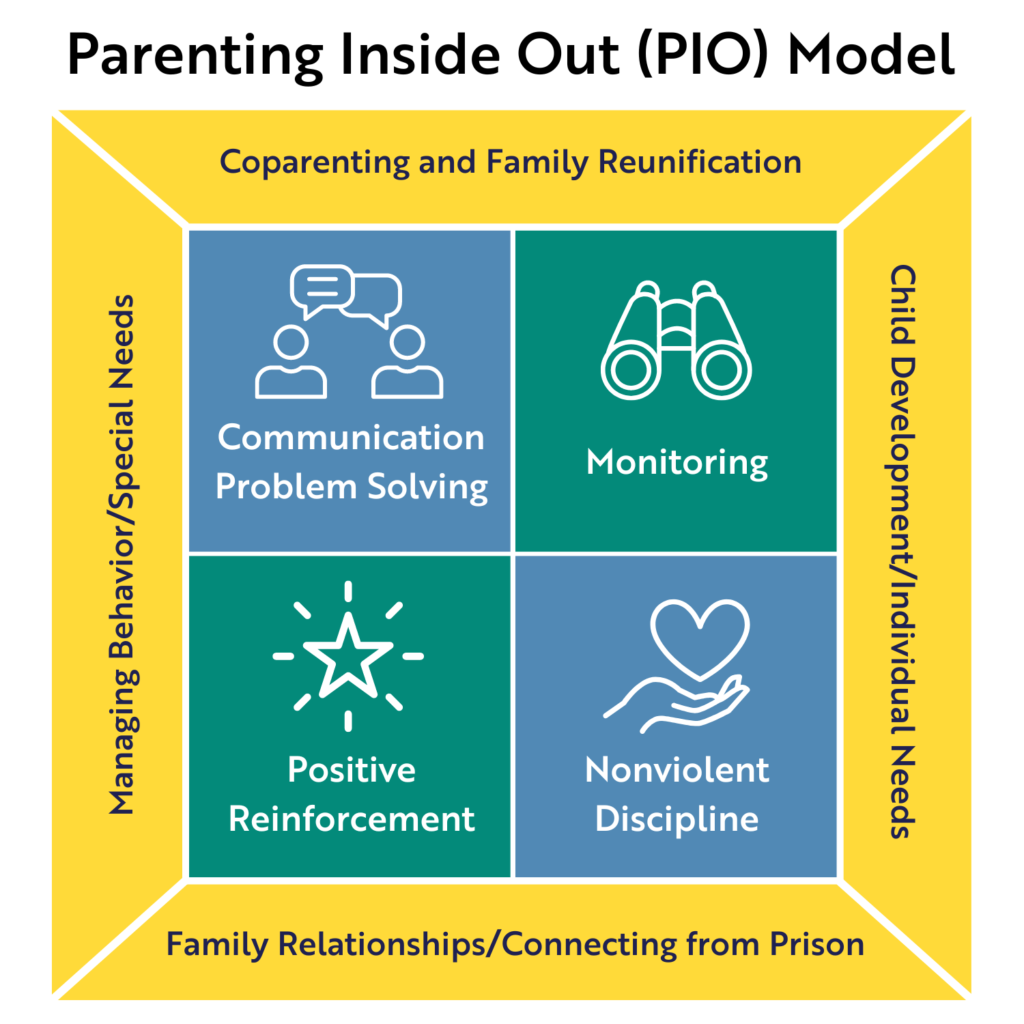
Our curriculum includes the core elements of parent management training: communication and problem-solving, positive reinforcement, monitoring, and non-violent discipline. Based on input from justice-involved parents and their families, parenting educators, and social service providers, PIO adds key topics such as co-parenting and family reunification, managing behavior and special needs, family relationships and connecting from prison, and child development and special needs to the PMT base to create a well-rounded parenting program for the population. PIO is the only evidence-based parenting program specifically for criminal-justice-involved parents and is the parenting curriculum of choice for corrections and community programs throughout the U.S.
Our Curriculum
Explore Different Versions of Our Curriculum
Each version of our curriculum teaches parents a way of navigating life that uses healthy, pro-social skills to interact with children, partners, co-parents, officials, friends, and family.
PIOP Prison 90
The first and longest version of PIO, developed for prison settings, is 90 hours in length. It consists of 36, 2.5 hour lessons typically taught over 12 weeks (3 classes/week).
- Most expansive and comprehensive topic list
- Ideal for longer-term or custody/residential settings
- Includes opportunities for enhanced hands-on parenting practice
- Sample Lesson
- Topic List
PIOP Prison 60
For institutions with less programming time available, there is the 60-hour version of the curriculum. The 60-hour program has been used in prisons and in jails with those who have longer sentences. It consists of 30, 2-hour lessons that can be taught over 10 weeks (3 classes/week) or 14 weeks (2 classes/week).
- Most widely used version in prisons
- Adaptable meeting schedule
- Includes opportunities for enhanced hands-on parenting practice
- Sample Lesson – English
- Sample Lesson – Spanish
- Topic List
PIOC Community 48
The community version of PIO consists of 24 2-hour sessions and is designed for parents in the community who are in work release or reentry programs and/or on parole or probation. Parents may or may not have custody of their children, or may be seeking visitation.
- Ideal for shorter-term settings
- Adaptable delivery for varying timelines
- Suitable for parents involved in systems beyond the criminal legal system
- Sample Lesson
- Topic List
PIOJ Jail 24
The jail program is the shortest program, consisting of 12 2-hour classes. The 24-hour version can be used in other settings as well, such as transition centers, treatment programs, or custody settings.
- Popular in a variety of settings
- Adaptable meeting schedule
- Sample Lesson
- Topic List
PIOP Prison 90
The first and longest version of PIO, developed for prison settings, is 90 hours in length. It consists of 36, 2.5 hour lessons typically taught over 12 weeks (3 classes/week).
- Most expansive and comprehensive topic list
- Ideal for longer-term or custody/residential settings
- Includes opportunities for enhanced hands-on parenting practice
- Sample Lesson
- Topic List
PIOP Prison 60
For institutions with less programming time available, there is the 60-hour version of the curriculum. The 60-hour program has been used in prisons and in jails with those who have longer sentences. It consists of 30, 2-hour lessons that can be taught over 10 weeks (3 classes/week) or 14 weeks (2 classes/week).
- Most widely used version in prisons
- Adaptable meeting schedule
- Includes opportunities for enhanced hands-on parenting practice
- Sample Lesson – English
- Sample Lesson – Spanish
- Topic List
PIOC Community 48
The community version of PIO consists of 24 2-hour sessions and is designed for parents in the community who are in work release or reentry programs and/or on parole or probation. Parents may or may not have custody of their children, or may be seeking visitation.
- Ideal for shorter-term settings
- Adaptable delivery for varying timelines
- Suitable for parents involved in systems beyond the criminal legal system
- Sample Lesson
- Topic List
PIOJ Jail 24
The jail program is the shortest program, consisting of 12 2-hour classes. The 24-hour version can be used in other settings as well, such as transition centers, treatment programs, or custody settings.
- Popular in a variety of settings
- Adaptable meeting schedule
- Sample Lesson
- Topic List
Core Topics
Key topics of the Parenting Inside Out Curriculum include:
- Giving effective directions and using positive reinforcement
- Adult development and parenting roles
- Emotion regulation (anger management)
- Child development
- Nurturing children through reading and play
- Family dynamics
- Problem-solving skills
- Child guidance and non-violent discipline techniques
- Transition planning and family reintegration
- Communication skills
Implementing PIO
How it Works
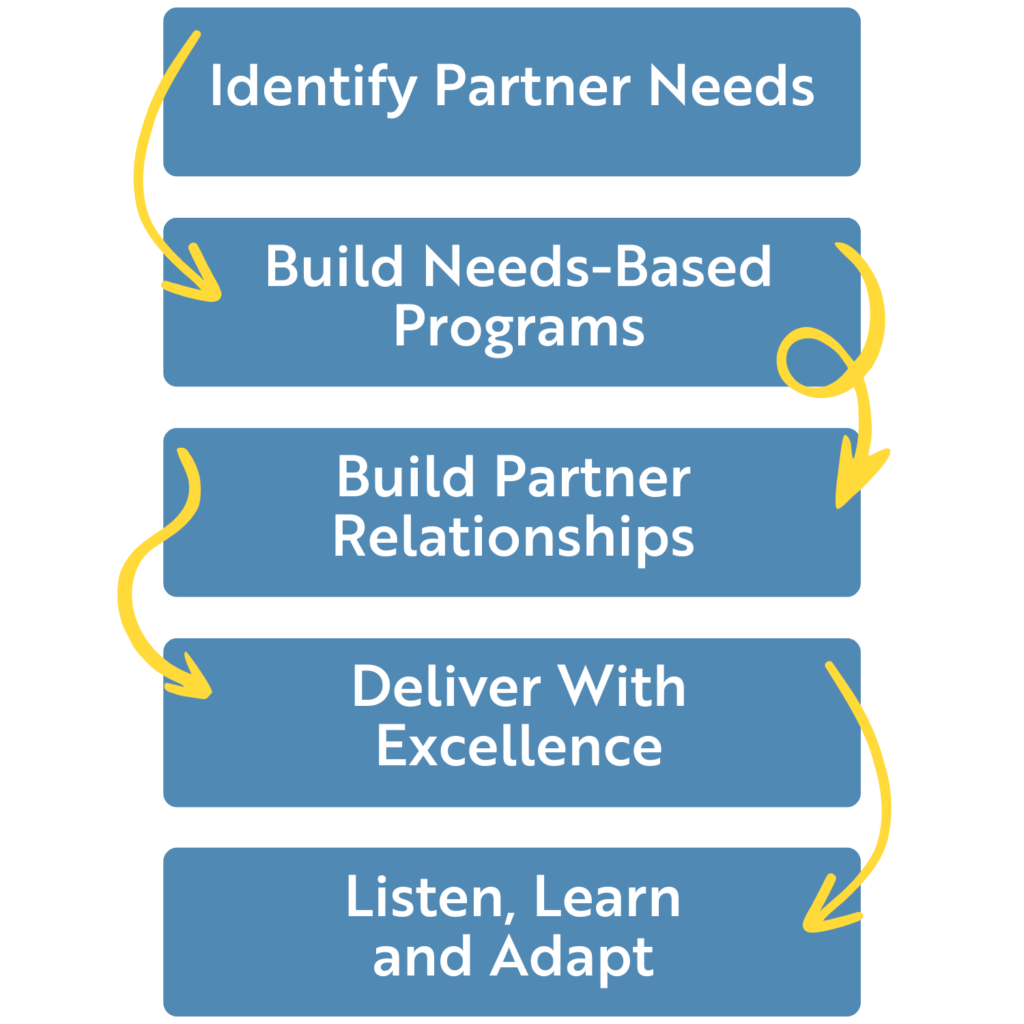
Together, we’ll create a tailored implementation plan that suits your unique needs. Our journey starts with an informative discussion to understand your goals and parameters. Following this, you’ll receive a customized pricing quote and then a licensing agreement, enabling unlimited access to parent-learner materials. You’ll then select the facilities, staff, and training dates that work best for your organization. After receiving and paying for the required licenses, manuals, and materials your staff will be trained and certified, typically within a month. With in-house certified PIO coaches and ongoing technical assistance throughout the training and implementation phase, you are set to deliver impactful PIO programming to parents, transforming lives and building strong families.
PIO Products and Services
Parenting Inside Out includes a customizable suite of tools and resources to support each partner agency’s implementation and effective delivery of the curriculum. Let us help match our program with what is important for you. Our products and services include:
- Curriculum licensing that authorizes organizations to use the curriculum and reproduce parent materials needed, for a one-time, upfront fee
- Complete curriculum manual with lesson plans and facilitation guides and resources
- A CD or USB drive with all participant materials — handouts, worksheets, graduation certificates, evaluation tools, etc.
- Instructional DVD’s to support curriculum delivery
- A training program that ensures curriculum fidelity and efficacy
- Ongoing support and technical assistance to support implementation
- Continuous quality improvement support and training, as needed and requested

Training
We provide training for all parenting coaches to ensure they are prepared to deliver the curriculum with excellence, as it was designed. We offer both in-person and virtual training, along with ongoing support, information sharing, and problem-solving, tailored for our trained coaches.

Resources
Discover our extensive library of resources designed to empower PIO coaches guiding justice-involved parents. We have developed a variety of tools to support your implementation and success in reaching the desired outcomes with the parents we serve.
Get In Touch
Can’t find the answer you’re looking for? Please send us a message and our friendly team will follow up with you as soon as possible.

Donate
Make a donation to The Pathfinder Network and help us provide support for systems-impacted individuals, youth, and families.